AI continues to shift how your customers are discovering your brand.
As the space has rapidly evolved, many are left feeling in the dark as to what’s actually happening at scale on AI search platforms. How does my brand show up in AI, and what can I do to optimize? Is it true that AI platforms aren’t linking out to websites? What sources are AI platforms trusting? Is AI deciding my brand’s positioning for me?
We’ve heard versions of these questions asked by our clients, our leaders, and ourselves. We sought to answer them in a classically Ovative fashion: by looking at the data.
The Dataset Behind Our Retail AI Visibility Analysis
As an AI and search optimization partner for many leading enterprise retailers, we have unique insight into a large volume of prompts specific to the retail industry. Our dataset includes:
- 1,087 unique prompts analyzed over a 9-week window
- 37,783 model responses tracked across ChatGPT, Claude, Gemini, and AI Mode
- 422,998 total citations
Armed with this data, we set out to better understand how retailers show up in AI responses by analyzing the following segments:
- Prompt Types: How brands show up and models populate responses across Informational, Consideration, and Transaction prompts.
- Model Types: Understanding if AI platforms more frequently respond with information from underlying models (Model Knowledge) or if they are actively retrieving live information (Search Augmented).
- This is critical insight as only Search Augmented responses will include citations and provide traffic-driving opportunity.
- Brand Mentions: How brands are mentioned and positioned in AI responses, and how that differs across platforms and prompt types.
- Cited Content Types: Which sources, content types, and content signals are most trusted by AI platforms.
With this insight, we can better understand how AI systems tick, and ultimately, leverage these insights to drive more effective AI search optimization strategies. This study is part of an ongoing series from our team on industry-specific AI visibility.
Key Findings: What Our Retail AI Search Analysis Revealed
- Across our retail dataset, 80% of tracked prompts provided a Search Augmented response with citations. This means that most AI responses in retail contain links, providing traffic-driving opportunities.
- Editorial content is critically important as nearly half of all retail AI Citations are either product recommendations or long-form content.
- Most AI brand mentions are not endorsements; they’re just mentions. We expected to see less neutrality but the reality is that only 25% of AI responses were actively recommending a brand.
1. AI Citations Are More Common Than You Think, and That’s Good News for Retail Traffic
Finding 1: 80% of our tracked prompts returned Search Augmented responses, meaning that AI models are more frequently providing citations and therefore traffic-driving opportunity for retail brands.
Why This Matters
Model response is the gate that citations sit behind, and it’s up to the AI models themselves how they choose to respond. Brands have no control over that. Without Search Augmented responses, citations don’t exist. And when citations don’t exist, there is no link for users to click on AI responses.
Businesses are fundamentally dependent on citations to drive measurable performance in AI. It’s encouraging to know that the underlying models are constructed in a way, at least for now, where AI can still be a viable performance-driving channel.
In our dataset, we did note some differences across different prompt types and model responses:
- The further down the funnel you go, the greater the likelihood of citations. This is logical, as the more specific and conversion-oriented you are, AI responses are weaving in a large variety of different sources, and in the retail sector, lots of products and category pages are being cited.
- Gemini is the one platform playing a different game than the others. Across informational prompts, other AI platforms respond with a Search Augmented response 89-100% of the time. Gemini does it 35% of the time, the rest is being answered from model knowledge alone.
Regardless of some of the model nuance, this is great news for brands looking to leverage AI to drive lower-funnel, high conversion intent traffic. Here’s a further breakdown of what we saw in our retail dataset:
| Prompt Type | % Search Augmented | % Model Knowledge | Platform Differences (% Search Augmented by engine) |
|---|---|---|---|
| Informational | 78.9% | 21.1% |
|
| Consideration | 81.8% | 18.2% |
|
| Transactional | 84.2% | 15.8% |
|
What This Means for Your AI Search Strategy
While AI certainly behaves differently than traditional search, the notion that AI does not create opportunities to drive traffic is categorically false.
Continue to prioritize your AI visibility and performance optimization efforts by:
- Improving site accessibility. Ensure your site is allowing AI bots and agents to access your content, and that your content properly renders.
- Optimizing your content for conversational relevancy and quality. Target phrases, questions, and concepts throughout your site that map back to what your primary audiences are asking AI for.
- Building offsite brand authority. It’s time to dust off that old PR playbook. Boost authority by building high-quality brand mentions and links in sources highly trusted by AI platforms.
While the landscape of AI results is shifting, know that the opportunities to drive performance from AI platforms are very much there.
2. Nearly Half of AI’s Retail Citations Go to Content Most Retailers Aren’t Investing In
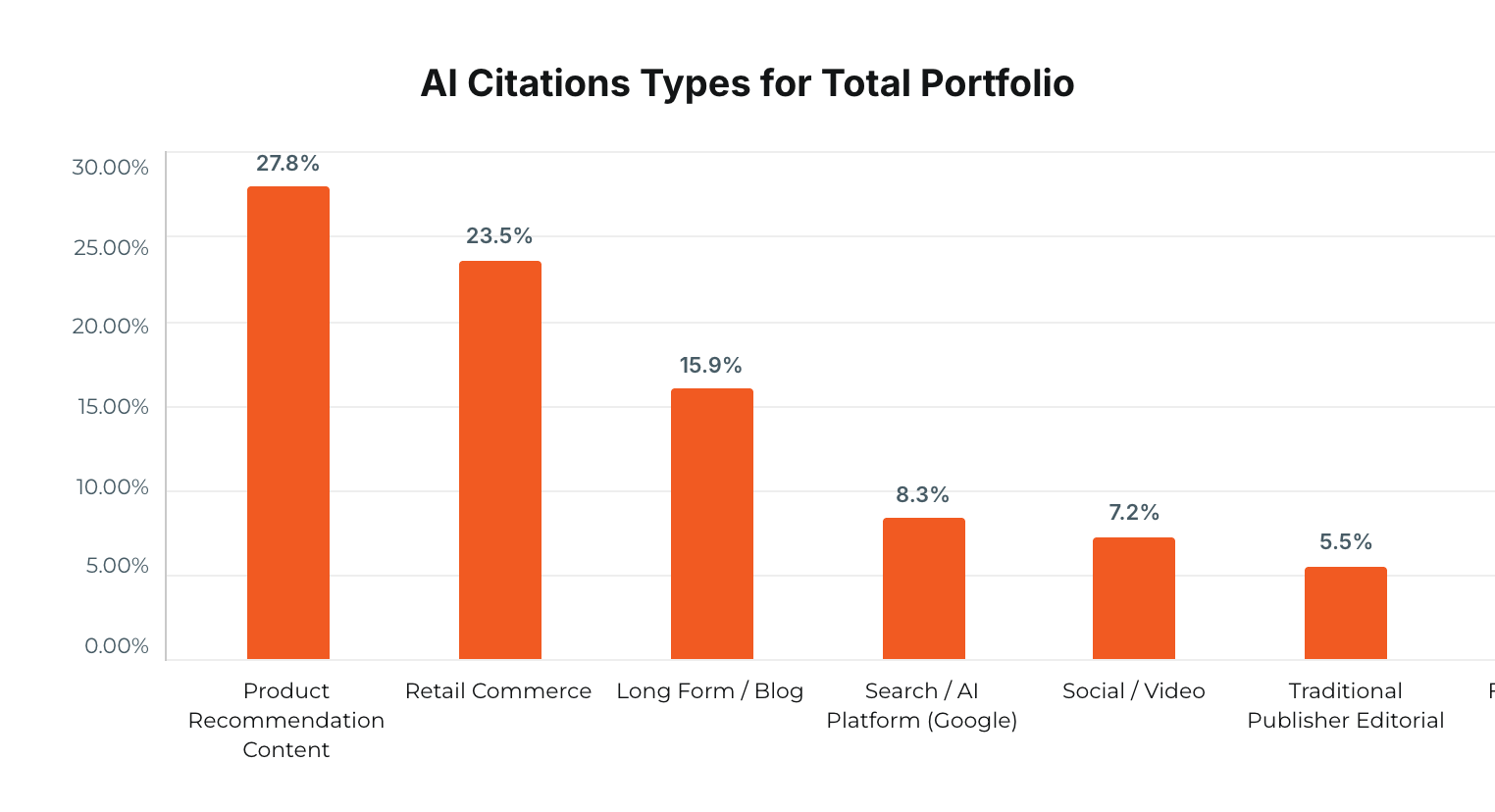
Finding 2: Editorial content is critically important as nearly half of all retail AI Citations are either product recommendations or long-form content.
Why This Matters
Understanding what domains and page types are being cited in AI platforms help us understand the content sources AI trusts, providing critical insight on where and how to publish content to increase visibility.
Expertise and Clean Structure Are What Earn AI Citations
Product recommendation content is the largest cited content type, accounting for 28% of citations. This content is classified as product ranking and recommendation content, with the overwhelming majority being affiliate content. Publishers cited most frequently for product recommendation content both had expertise in the category, and structured their content in a way that is easy for AI crawlers to read and trust, explicitly including 2026 or ‘best for’ language within them. A few sites winning in the space are WhoWhatWear, Forbes, and Business Insider. Their mix of expertise and trust built within their long-form articles combined with their product recommendation content make them a trusted source in AI’s eyes leading to their success in the space.
Long-form content made up 16% of total citations, inclusive of informational blog content. Within cited long-form content, expertise shines through as a trustworthiness signal to AI. Cited content was largely from hubs from category expert blogs and guides like REI and Whirlpool. Unsurprisingly, informational prompts were the largest prompt category, making it important for retailers to portray their expertise and understanding for customer questions and needs by creating this content.
Transactional prompts overwhelmingly drove to Retail Commerce pages, largely from “where to buy…” prompts. ChatGPT cites the largest quantity of pages, which are primarily store location pages that pull from an interactive map with some specific product recommendations that cite PDPs. Other platforms like Gemini and AI Mode largely cite top rated PDPs with shoppable experiences, signaling the eventual shift to and integration of a truly agentic model.
YouTube and Reddit are often referenced as top citation sources. By domain this may be true as they come in second and third, but social and forum citations only make up 7% and 4% of total citations respectively. Additionally, we saw Reddit citations decline -1% from June to July, driven by ChatGPT and AI Mode. Volatility has continued as Reddit citations saw declines in August across the industry. Claude over-indexes in social and forum citations, with 13% social citations and 6% of citations attributed to forums, followed by AI Mode. Other content types also made up a small share of total citations.
What This Means for Your AI Search Strategy
The data is clear: content wins in AI search. To increase visibility, investing in product recommendations, offsite content, and building helpful content on your site will help build authority and trust with AI platforms and customers.
Other page types, such as traditional retail page types, are being cited within platforms on prompts with high intent, so it is important to keep pages well maintained to capture users at the bottom of the funnel.
Actions your brand can take to optimize include:
- Invest in product recommendation content. Partner with affiliate teams to invest in buys with highly cited and authoritative publishers within your industry.
- Prioritize traditional e-commerce pages. Don’t forget about keeping core e-commerce pages follow search ongine Optimization (SEO) best practices, including helpful product descriptions and copy blocks on product landing pages (PLPs).
- Build industry-relevant long-form content. Showcase expertise by creating blog content that is highly relevant to your industry and answers the specific questions users are searching AI platforms to solve.
3. AI Is Far More Neutral About Brands Than Marketers Assume
Finding 3: With only 25% of AI responses actively recommending a brand, most AI brand mentions are not endorsements, they’re just mentions.
Why This Matters
There’s a common belief across marketers that AI platforms are influencing consumer opinions significantly in their responses, and while that may be true in some contexts, it appears far less frequently in retail.
Of the 220k brand mentions in our dataset, 70% of brand mentions contained no evaluative or endorsement language at all.
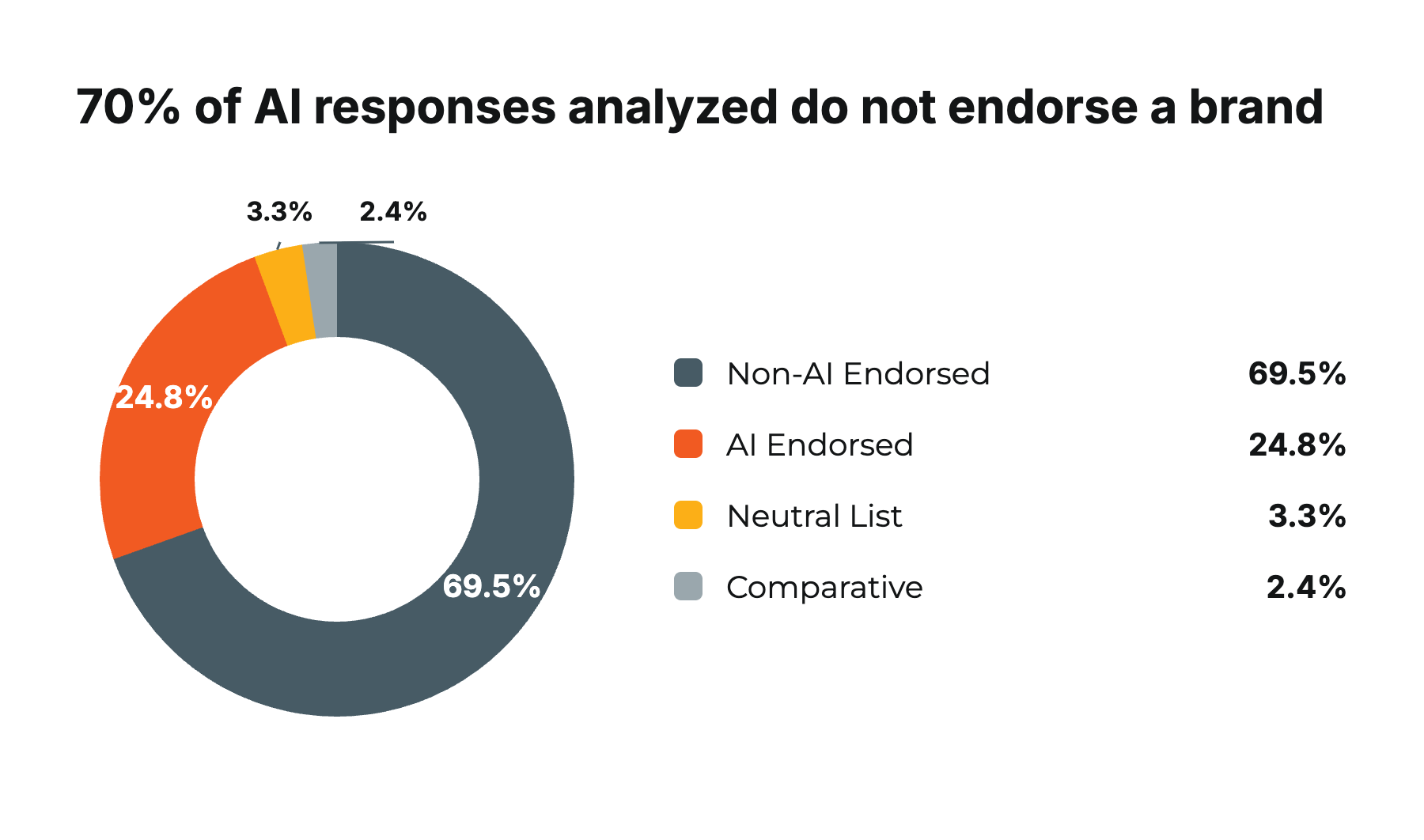
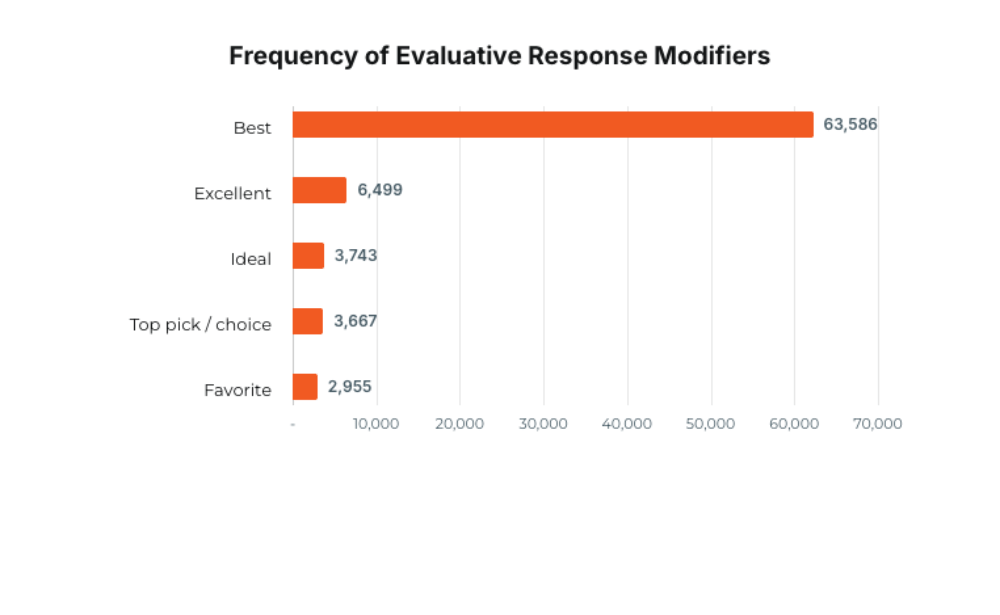
Only 25% of responses included active recommendation language like ‘best’, ‘top pick’, ‘stands out’, ‘award winning. Claude led the pack with strongest endorsement rates at 38%, ~2.5x higher than AI mode, which was the most neutral of the bunch.
What This Means for Your AI Search Strategy
It’s important to understand that while AI platforms certainly help consumers evaluate options and make purchasing decisions, they are far more neutral than you likely expect.
Regardless, track important informational, consideration, and transactional prompts, and watch what AI is saying about you. Analyze AI responses to understand the tone and nature in which your brand is referenced, especially in the context of competitors. If you have work to do, focus efforts on creating authoritative content and securing mentions from authoritative third-party sources, then track changes in AI responses.
While this is likely to change as models evolve, it’s encouraging to understand that AI platforms provide a more level playing field as of right now.
AI Search Stops Being a Mystery Once You Have the Data
So what does this all add up to? AI search isn’t the black box it can feel like. It’s a channel with real rules, real nuance, and as we’ve shown across more than 37k responses, real opportunity for brands willing to meet it on its terms.
The throughline across all three findings is the same: citations aren’t rare, content quality is what earns them, and AI platforms are still remarkably neutral about who they surface. That combination is critical insight for brands optimizing today.
Bring it back to fundamentals: keep your site accessible to AI crawlers, build content that actually answers what your customers are asking, and invest in the kind of offsite authority that gets you cited, not just mentioned. Do that, and AI search stops being a mystery and starts being a growth channel.
This is only the first of our industry-specific AI visibility studies, and we’ll keep digging as the space evolves. Have questions about what this means for your brand specifically? Let’s talk.
Ready To See How Your Brand Shows Up in AI Search?
Ovative’s search experts take a holistic approach that considers organic search, SEM and AI visibility as a connected system.
Solutions for AI readiness include site structure work, content planning for LLMs, and effective measurement frameworks. Contact Ovative to get started with an audit of your current AI visibility.